Equality And Privilege In Four (And A Bit) Really Simple Graphs
Please excuse the crudity of this model, I didn’t have time to build it to scale or to paint it. (points if you get that reference *wink*)
This is my explanation of how the process of achieving equality is believed to work and how it actually should work. I’ve labeled the graphs with men and women, but it can also be applied to religion, sexual orientation, etc. anyplace there’s a dominant group and an other or others.
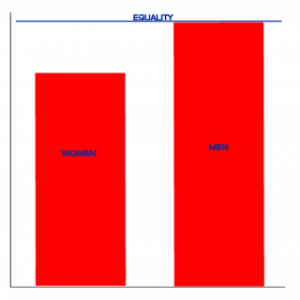
We start with a graph of what a lot of people probably think the current situation is:

In this belief, the place men are at is what we’re aiming for, and women are not there yet but somewhere near it (YMMV as to close how or far you think we are).
Now with this graph in mind it’s understandable that people don’t like the idea of affirmative action. After all, wont this be the result if we give women “special advantages” that men don’t get.

Oh noes! Matriarchy! *screams in terror*
The problem is that the first graph is wrong. That’s not actually where we’re at or what we’re aiming for. The true graph of the current situation starts out looking like this:

Again YMMV on where the women exactly start out. The important part is that the position that men are currently in is not at that equality line. It’s easier to grasp what I’m on about if I add an little extra bit of text to this graph…

Oh noes! Patriarchy! *screams in terror*
So, the correct way to frame this is actually what happens if we stop giving the affirmative action to men and give it to women instead for a while.

Bingo! That’s the theory anyway.
Of course there’s loads of debate to be had about how well this works, or how to implement it. Some of those ideas will be better than others. Some may well be stupid and not work at all, those need recognising and not doing again. Others will have the right effect.We have no proven template for this. It’s trial and error.
The process of removing privilege for one group is really hard on them – because it is taking something away – and that needs to be recognised too or we’ll get nowhere near equality. Members of a dominant group may not even understand that they are the dominant group and that they enjoy unnatural privilege over others. Culture and history will have told them that this is how the world is and should ever be. They’ll kick back instinctively against any challenge to that, and that doesn’t necessarily make them bad people. Some will not feel dominant at all because of other intersecting factors (such as class or race or religion), so explaining to them that they are dominant will often fall on deaf ears. The man fighting a very personal custody battle for his kids doesn’t necessarily know that less than a hundred years ago there would have been no battle. That he’d have been given the kids as a matter of course, and that the mother would have simply had no say at all in the matter and, in fact, could well have been sent to a mental institution just to get rid of her. He sees a system where women now have a small amount of sway and only has the vaguest knowledge that things used to be different somehow. As we try to gain equality for all, many people will continue to see only the second graph and not the last one.
Some issues can only be brought to a head through confrontation of them and implementing structures to create normalisation of a different mode of thinking. Culture doesn’t just happen spontaneously. However confrontation itself can only take us so far. Real change needs education and understanding. We’re still just at the beginning and still stumbling in the dark.

You May Also Like

Halloween 2020
One Team: Bringing Design and Development Together
